Phone: +86-755-2357-1819 Mobile: +86-185-7640-5228 Email: sales@ominipcba.com whatsapp: +8618576405228


OminiPCBA: Shipping Policy
At Omini, we understand the importance of timely and safe delivery of finished PCB products to ensure customer satisfaction and reliability. Our goal is to provide smooth shipping experiences for every client.
Shipping Incoterms for PCB Manufacturing and Delivery by Omini
OminiPCBA provides flexible logistics solutions, supporting a wide range of global shipping terms from Ex-Works (EXW) and FOB to DAP and DDP. Whether you prefer to manage transport via your own carrier or require seamless door-to-door delivery with duties prepaid, our shipping workflows are designed to integrate with your specific supply chain requirements. We prioritize predictability and transparency, ensuring that every PCBA shipment reaches its destination without unexpected delays or costs. By offering versatile Incoterms, OminiPCBA adapts to your internal procurement processes, delivering high-reliability PCB solutions with a logistics strategy that matches your operational needs.
Shipping Modes for PCB Deliveries: Express, Air, and Ocean
Omini offers several ways to ship your order, depending on what works best for you - like fast delivery, air transport, or sea travel. When your PCBs are finished and set to go, we’ll email you a full packing slip along with a suggestion that balances speed, price, and your personal preferences. Here’s how each shipping choice stacks up against the others
1. Express Freight Best for Under 50 Kg
Transit Time 3 to 5 Days
Freight Costs Remain High
Shipment Safety High
Best Option for Shipments Under 50 Kg
2. Air Freight Ideal for Shipments Between 50 and 500 Kilograms
Transit Time 7 to 14 Days
FREIGHT COST MEDIUM
Shipment Safety Is High
Best option for shipments from 50 to 500 kg
3. Ocean Freight Best for Over 500 Kg
Transit Time 25 to 40 Days
FREIGHT COST LOW
Shipment Safety Medium
Best option for shipments above 500 kg
High-Quality Packaging for Safe PCB Delivery
OminiPCBA leverages over 15 years of logistical expertise to ensure your high-precision PCBAs are protected during every stage of transit. We utilize specialized, impact-resistant packaging materials specifically engineered for delicate electronics and sensitive circuitry. By prioritizing custom-fit packing solutions and rigorous handling protocols, we eliminate the risk of ESD or mechanical damage. Our commitment to secure electronics fulfillment ensures that every shipment arrives with its technical integrity fully intact, meeting the strict reliability demands of global engineering teams.


Omini PCB Packaging Process
At Omini, we follow a meticulous packaging process to ensure that your printed circuit boards (PCBs) are safely delivered in optimal condition. Our packaging steps include:
Post-inspection, OminiPCBA seals every batch in vacuum-packed ESD bags, typically containing 10 to 25 panels to ensure optimal protection and handling. Every PCB assembly is packaged immediately following quality approval to prevent contamination and maintain technical integrity.
Each moisture-barrier bag includes a calibrated humidity indicator card (HIC) and high-grade desiccant packets to regulate internal conditions and prevent oxidation. This integrated moisture-control system ensures your printed circuit boards remain in shelf-stable condition throughout transit and storage.
For full traceability, every package features a comprehensive identification label detailing the part number, job reference, quantity, date code, and batch specifications. This rigorous labeling protocol supports seamless inventory management and provides the complete production transparency required for industrial and mission-critical electronics supply chains.
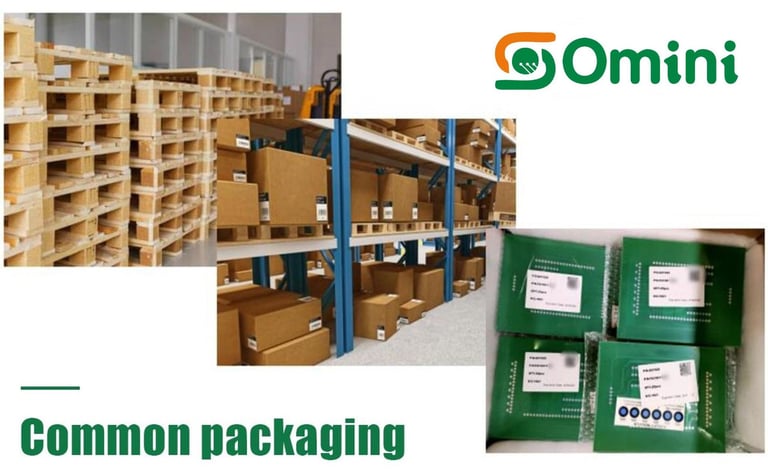
OminiPCBA utilizes double-wall corrugated cartons reinforced with high-density foam cushioning to safeguard PCB assemblies during transit. Each vacuum-sealed unit is nested within shock-absorbent layers to prevent mechanical stress and movement. To ensure ergonomic safety and minimize handling damage, we maintain a strict weight limit of 15kg per carton.
Our final packaging phase involves secure industrial sealing and comprehensive labeling for full supply chain traceability. Every carton is marked with the part number, PO reference, quantity, and date code. For high-volume shipments or sensitive hardware, we provide reinforced palletization to enhance structural stability and provide an additional layer of protection against rough handling.
The OminiPCBA packing process prioritizes ESD safety and physical integrity from the moment assembly is complete. We utilize a multi-stage shielding approach:
Primary ESD Shielding: Every PCBA is immediately placed in a premium anti-static bag following quality clearance to prevent electrostatic discharge.
Secondary Protection: A heavy-duty ESD overwrap is applied to double the dielectric protection.
Cushioning & Partitioning: Boards are secured within cartons using custom foam inserts or personalized dividers, preventing component-to-component contact and absorbing transit vibrations.
Sealing & Tracking: Cartons are reinforced with heavy-duty tape and labeled with precise batch data. For international or heavy-duty freight, we utilize heat-treated pallets to ensure a secure, zero-damage delivery to your facility.
Contacts
Email: sales@ominipcba.com
Mobile: +86-185-7640-5228
Copyright © 2007-2026. Omini Electronics Limited. All rights reserved.
Head Office: +86-755-2357-1819
Services


Your China turnkey partner for electronics manufacturing. We bridge design to delivery by leveraging the Shenzhen electronics ecosystem for precision engineering and streamlined PCBA supply chain logistics.
Ready to Build?
Get a comprehensive quote within 24 hours.