Phone: +86-755-2357-1819 Mobile: +86-185-7640-5228 Email: sales@ominipcba.com whatsapp: +8618576405228

Strategic Vetting of Fast-Turn Flex PCB Manufacturers
Speed often masks manufacturing flaws in flexible circuits. Learn to evaluate material stability, SMT on flex precision, and rapid scaling benchmarks.
PCB TECHNOLOGYPCB MANUFACTURINGPCB ASSEMBLY
OminiPCBA
2/11/20265 min read
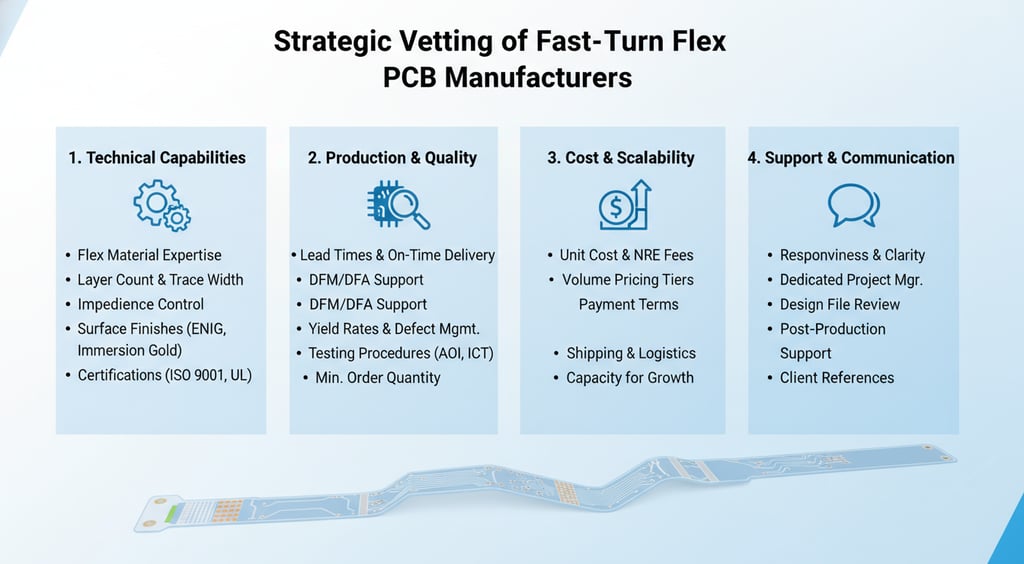
Wearable tech spreads fast. Foldable phones pop up everywhere. Aerospace gear packs more sensors than ever. Flexible circuits used to be rare. Now they hold things together. Deadlines get tighter every day. Needing quick results pushes people toward fast-turn factories. That rush might ignore key details - like how materials bend or resist heat. A wrong choice here means circuits fail later. Trust matters less than what happens under pressure. Watch how well layers stay aligned when heated. Material knowledge separates okay suppliers from ones you can rely on. Speed without control creates weak links. Hidden flaws grow quietly. Performance cracks show too late. The real test hides in chemistry and movement, not promises.
The Material Foundation Beyond Standard FR4 Thinking
Most flexibility in a circuit comes not from its design but from the material underneath - typically a type of plastic called polyimide. Instead of assuming all versions work the same, it helps to check what class the polyimide belongs to along with how it's glued together. Some cheaper makers skip quality steps here, opting for weak bonding agents that release gas under heat. When that happens during soldering, trapped fumes can tear layers apart or create cloudy spots once heated.
A pivot point in performance often hides where you least expect - inside the copper layer. When circuits stay put after setup, electro-deposited kinds hold up just fine. Yet they fall short when constant movement enters the picture - their internal layout can’t endure relentless folding. Think of parts that twist thousands, even millions, of times: a screen that opens daily, an arm that rotates nonstop. There, only rolled annealed material delivers what's needed. Strong endurance hinges on how crystals align inside the metal. Anyone building these systems must demand proof, clear details showing grain direction matched to stress demands.
Coverlay and Solder Mask Alignment Accuracy
Protection in bendy circuitry often comes from a coverlay - think of it as a shield made of polyimide stuck on top. Instead of being printed like paint on stiff boards, these layers get shaped by physical cutting or lasers. That method makes lining things up tricky. When tools slip even slightly during setup, the covering might creep over spots meant for soldering. Then joints shrink where they shouldn’t, or bare metal shows through, ready to rust if moisture gets in.
It's common for shops moving toward rapid production to overlook climate control after drilling but before layering circuits. Since polyimide pulls water from the air without hesitation, dampness builds fast inside the material. When wet film gets pressed too soon, hidden pockets of vapor form under heat, leaving tiny gaps where bonds should be solid. One leading producer handles this by holding materials in dry chambers first, then slowly pulling out humidity step by step - part of their routine process to keep layered flexible boards strong and reliable.
Flexible Substrate SMT Difficulties
Something floppy beneath parts changes everything when machines try to place them. Standard setups struggle because they expect something stiff underneath. For bendable boards, special trays step in - people call these carriers. They keep the wavy material steady while glue gets added and pieces get set down. When those supports miss their mark, tiny differences rise up. Too much or too little goo spreads around. That unevenness tips small parts upright like tombstones or leaves joints weak where connections matter.
How heat moves during reflow trips up many standard EMS factories. Unlike stiff boards, flex circuits soak up warmth quickly - then lose it just as fast. Each flex job needs its own heating pattern, shaped carefully so the polyimide stays strong and glue doesn’t seep where it shouldn’t. Instead of one-size-fits-all ovens, some makers tweak airflow to match delicate layers. Real-world results from firms like Ominipcba show flooding tiny zones with nitrogen helps solder stick better, while still letting the base stretch and bend.
Stiffener Integration with Mechanical Transitions
Hardly any bendable circuits work well without something solid backing them up. When a connection point needs stability, FR4 adds firmness; in shaky conditions, thin steel sheets do the job instead. How these supports stick matters most. Sticky films applied by hand show up often in basic uses, yet gear built for tough jobs usually relies on heat-activated bonds to hold stiffeners tight.
Where the stiff part meets the bendable section - that spot often fails first. Smart makers check how tightly your layout can turn, then add rounded corners or smooth joins where lines meet pads. Getting this right turns a basic builder into someone who solves problems before they happen. Strengthening these spots keeps metal from getting brittle and breaking when things get put together.
Vetting With Technical Details Beyond Delivery Speed
Start with this: delivering a complex flexible circuit in two days means hitting every mark across twenty delicate steps. See past the claims by checking real data - cross-sectional analysis shows what happens inside drilled holes. Microscopic views expose how well copper coats those walls. Surface layers tell more, especially when looking at ENIG deposits; their depth matters. Find proof in lab results, not brochures.
When making electronics fast, how quickly you get things right the first time is what counts most. Rushing through chemical baths to cut four hours might give a clean-looking board that still fails tests for invisible residue. Firms like Ominipcba show better results by using machine vision checks early and often - spotting tiny alignment errors as soon as they pop up. What happens mid-process shapes the outcome more than anyone admits.
The Value Of Turnkey Pcba In Flex Projects
One wrong fold during shipping can ruin a flexible circuit. Moving parts between factories means more handling - that raises the chance of static harm. Instead of passing pieces around, some companies handle everything themselves. This way, making the board, buying parts, and placing them stays under one roof. Fewer transfers mean fewer things go wrong along the way. Responsibility lands on just one team, so problems are easier to trace. Bending risks drop when there is less back-and-forth travel.
With this setup, checking how parts go together becomes way clearer. Engineers tweak how flexible circuits are grouped so the frame fits better, which cuts down extra materials and brings individual prices lower. When buyers see what's happening through production, they avoid traps of low upfront pricing - saving a small amount at first might wreck half the batch later.
Scaling Through Engineering Connections
One wrong move in fabrication makes even quick prototypes pointless down the line. Where most small firms stumble isn’t design - it’s crossing into full volume. Same materials, same machines, whether building ten or ten thousand. That match keeps electrical behavior consistent from test board to final batch. Running differences risks unseen failures when scaling up.
When checking a maker’s capability chart, watch how they manage tricky details - stacked holes hidden inside layers, pages bound like a book. Devices shrink. So handling layered connections on bendable boards shifts from option to must. Confidence grows when a builder nails tough builds fast. That trust moves hardware ideas further.
Technical Factors in Choosing Partners
Choosing a quick-turn flexible circuit maker comes down to what the numbers show. Not hopes, not promises - just results seen through clear facts pulled from real performance.
Start by checking where materials come from. A solid supplier often means better quality down the line. Think of names such as DuPont or Panasonic - known players matter here. Their reputation adds weight to what ends up in production.
Fixturing skills: Are custom SMT carriers made internally using design and milling processes?
A closer look at cleanroom rules shows flex circuits need stricter environments. Rigid boards don’t demand quite the same level - dust hiding under coverlay can ruin delicate trace paths. So tighter air quality controls come into play when making flexible versions.
Start by checking how deep their design-for-manufacturing thinking goes. Watch whether the engineers propose features like fillets or anchor spurs. See if they actually analyze, or simply push print without adjustments. Notice what comes up when details get discussed. A real test shows up in those moments - thoughtful tweaks versus instant output.
When hardware teams build around solid technical foundations, they find partners who bring more than fast production - durability and strong output matter just as much. Fast means little if flaws follow. What holds up over time shows real success. A steady pace beats quick failure every single time.
Related Articles
Contacts
Email: sales@ominipcba.com
Mobile: +86-185-7640-5228
Copyright © 2007-2026. Omini Electronics Limited. All rights reserved.
Head Office: +86-755-2357-1819
Services


Your China turnkey partner for electronics manufacturing. We bridge design to delivery by leveraging the Shenzhen electronics ecosystem for precision engineering and streamlined PCBA supply chain logistics.
Ready to Build?
Get a comprehensive quote within 24 hours.