Phone: +86-755-2357-1819 Mobile: +86-185-7640-5228 Email: sales@ominipcba.com whatsapp: +8618576405228

Navigating the True Cost of Cheap PCB Manufacturing
Is ultra-low-cost PCB fabrication worth the risk? Analyze technical trade-offs, hidden manufacturing expenses, and how to optimize for value in high-reliability PCBA.
PCB TECHNOLOGYPCB MANUFACTURINGPCB ASSEMBLY
OminiPCBA
2/13/20264 min read
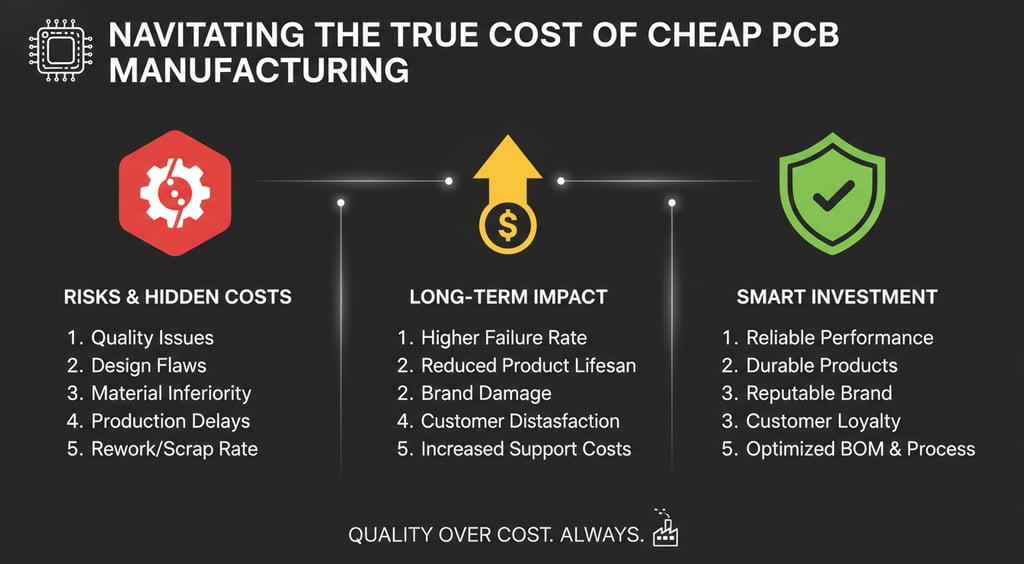
A chase for the lowest-priced PCB maker usually kicks off a tangled balancing act - immediate savings weighed against how well the product lasts. Within electronics manufacturing, what shows on a price sheet isn’t always what you end up paying. Grasping what shapes those costs means stepping into worlds like material behavior, movement of parts across global networks, even the cold logic behind how many boards survive production unflawed.
The Structure of a Cheap Quote
A maker cutting prices well under normal levels usually does so by changing how things are built. It often starts with the base material. FR-4 isn’t always the same; cheaper versions can have uneven electrical performance or weak heat resistance. Though a sample board might look fine at first glance, problems show up later - like layers splitting apart or signals failing when speeds rise or temperatures shift.
With pooling, cost savings come from shared space on a board. Instead of separate runs, many layouts get grouped together during making. This cuts waste but brings uneven results. Where thick copper suits high current paths, thinner layers serve delicate signals better. When both share a panel, the chemical etch can’t fully satisfy either need. One part might end up too thin, another less precise than needed.
Technical Trade-offs Beyond the Green Solder Mask
A cheap board versus a high-end one? It comes down to what happens behind the scenes. Hidden steps shape the gap.
Avoiding delays sometimes means cutting corners - drilling faster leaves jagged edges inside holes. When copper coats uneven surfaces during plating, gaps show up where connections should form. Heat cycles worsen thin spots until tiny cracks appear without warning. Breaks like these act unpredictably, making them hard to catch early.
Starting with how smooth a surface feels, finishes like hot air leveling, nickel-gold plating, or organic coating each behave differently over time. Because thickness matters, cutting corners on dip duration - say, with nickel and gold - can leave spots dark and weak underneath. That rough patch shows up later when parts refuse to stick properly during machine placement. Purity plays a quiet role too; if skipped steps pollute the layer, connections fail without warning. Even small changes in timing affect how long boards last before assembly.
Getting the solder mask lined up just right matters most with tight-pattern parts such as BGAs. Even a tiny misalignment on lower-cost boards might leave bare copper showing or cause solder to connect where it should not, which often means more faulty units when putting them together.
The Assembly Equation SMT and Yield Rates
One step beyond an empty circuit board brings many moving parts into play. Picking the lowest-cost builder usually leaves out high-end checking tools. Tough quality standards, like the ones Ominipcb keeps, rely on 3D vision scans along with X-ray views for buried connections.
One reason some budget-friendly factories skip advanced checks is they only use basic flat imaging. Sometimes, workers just look at boards by hand under a light. That cuts down immediate expenses on each connection point. Yet hidden flaws often slip through - like too little metal paste stuck to a contact area. Tiny blobs of melted wire coating can stay unnoticed. These specks may suddenly bridge circuits after weeks of normal use. Equipment used in hospitals or power systems cannot afford even one breakdown later on site. Fixing one malfunction out there runs much higher than paying more upfront for better oversight.
Regional Shifts and Clear Supply Chains
Out in the open, location shapes how we see low cost against real worth. Shenzhen still leads when it comes to affordable gadgets, thanks to an unmatched web of parts suppliers. Yet what really sets it apart isn’t only wages on the floor - speed matters more. Getting pieces exactly when needed cuts waste before it starts.
A producer such as Ominipcba uses close relationships to buy real parts straight from approved suppliers. On the flip side, one chasing only low prices could pull stock from unofficial channels when supply runs short. That path opens the door to fake pieces - chips possibly relabeled, pulled from discarded gear, or built wrong. When a phony chip acts up, results might include sluggish performance - or sudden breakdowns across the whole setup.
Design for manufacturing shapes cost efficiency
It turns out that cutting expenses works best when you rethink how something is built, rather than pressuring suppliers to charge less. Working closely with a skilled maker early on opens up smarter choices before anything gets made. Take drilling holes - using just one or two standard sizes instead of many brings savings quietly. Skip blind or buried vias unless they truly add value; otherwise they only raise price tags. Even small details like aligning parts properly for even heat exposure in ovens help lower cost behind the scenes.
When you stick to 1.6 millimeters for board thickness and 1 ounce of copper whenever it works, factories can pull material right off their usual shelves. A budget builder may respond to high-power needs by plating every layer heavier if your design calls for 2 ounces. On the flip side, someone who knows circuits well would ask whether using broader lines on thinner copper gives you what you need at lower cost.
Scaling Up And The Unseen Price Of Early Models
Some builders go cheap at first, sticking to quick mockups. Trouble shows up once scaling begins. When early versions rely on shaky methods, factories pushing big batches might struggle to match them. That mismatch can force an entire redesign from the ground up.
When engineers pick a solid manufacturing standard such as Omnipcba early on, the first working model mirrors what mass production will deliver. Sticking to that approach stops hidden problems from building up later - problems caused by cutting corners during initial builds using loose, inexpensive methods.
The Final Verdict on Total Cost of Ownership
Start counting only when you include everything. Hidden fees show up later, even if the first price looks small. Mistakes in production add expenses fast. Delays eat time, which means more money spent. Quality problems lead to extra rounds of fixes. Shipping surprises appear out of nowhere. Poor support stretches troubleshooting hours. Each misstep raises the real total. What seemed low at first ends up much higher
Initial Quote Price
Cost of Assembly Scrap (Yield Loss)
Cost of Rework and Debugging
Cost of Warranty Returns and Brand Damage
One way to look at suppliers is by stepping back from just unit price and seeing what total ownership really costs. Quality production means sticking to IPC-A-610 rules, running strict tests on ionic residues, showing where materials come from - clearly. Though initial prices go up slightly because of this, think of it like avoiding disaster later instead. Fewer surprises happen when something goes wrong after release, especially if a launch falls flat or recalls strike.
Related Articles
Contacts
Email: sales@ominipcba.com
Mobile: +86-185-7640-5228
Copyright © 2007-2026. Omini Electronics Limited. All rights reserved.
Head Office: +86-755-2357-1819
Services


Your China turnkey partner for electronics manufacturing. We bridge design to delivery by leveraging the Shenzhen electronics ecosystem for precision engineering and streamlined PCBA supply chain logistics.
Ready to Build?
Get a comprehensive quote within 24 hours.